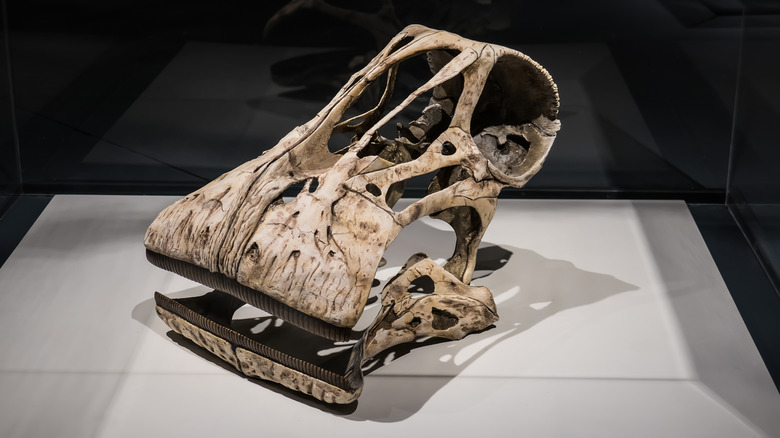
Fresh attention has turned to Nigersaurus taqueti, the dinosaur with 500 teeth, as paleontologists sift through ongoing excavations in Niger’s Sahara. Recent field seasons have yielded fragments that sharpen focus on its dental batteries, prompting comparisons to modern grazing animals. Public exhibits at major museums now feature reconstructions emphasizing the sheer volume of those replaceable teeth, drawing crowds amid broader Cretaceous exhibits. Which dinosaur has 500 teeth remains a point of fascination, not least because new CT scans reveal how those teeth sheared vegetation nonstop. Coverage in scientific journals underscores the anomaly—over 500 teeth in active use, far exceeding typical sauropod counts. This renewed scrutiny stems from expeditions building on Paul Sereno’s 1997 finds, where fragile skulls first hinted at the extent. No other dinosaur matches this dental density, and current analyses probe why evolution favored such excess in a mid-Cretaceous browser. The topic lingers because fossils keep emerging, each piece complicating prior assumptions about sauropod feeding.
Discovery and Naming
Initial Finds in Niger
French paleontologist Philippe Taquet spotted initial Nigersaurus remains during 1965-1972 expeditions across Niger’s Gadoufaoua region. Sandstone layers yielded scattered bones, too fragmentary for full identification then. Those early pieces suggested a sauropod unlike any known, with hints of an oversized dental array. By 1976, Taquet noted the material in publications, but poor preservation delayed deeper study—bones air-filled and brittle, prone to crumbling. Which dinosaur has 500 teeth started coalescing around these hints, as jaw fragments showed multiple tooth positions. Local crews braved extreme heat, unearthing vertebrae and limb elements amid shifting dunes. Taquet’s work laid groundwork, yet full context awaited American teams. Niger’s remote terrain complicated logistics, with floods sometimes halting digs. Still, those first fossils established Nigersaurus as a Cretaceous oddity, its teeth count emerging from partial maxillae.
Sereno’s 1997 Breakthrough
Paul Sereno’s team rediscovered Nigersaurus in 1997, targeting Taquet’s bonebeds for better specimens. They uncovered a partial skull so thin light passed through it, alongside neck vertebrae. This haul confirmed over 500 teeth across 68 upper and 60 lower jaw columns. Digitized CT scans allowed reconstruction, revealing transverse tooth rows unique among tetrapods. The dinosaur with 500 teeth gained form here—slender crowns in batteries, each backed by nine replacements. Field notes described the site as isolated, temperatures soaring past 110°F. Crews jacketed bones in plaster, hauling them to Chicago labs. Sereno dubbed it a “Mesozoic cow” for ground-level grazing traits. Those 1999 descriptions named it Nigersaurus taqueti, honoring Niger and Taquet. Subsequent 2000 digs added a near-complete skeleton, curving 15 feet in situ. Such progress reframed rebbachisaurids entirely.
Challenges in Fossil Preservation
Nigersaurus bones pneumatized heavily, air sacs hollowing struts to millimeters thick. Skulls disarticulated easily, scattering in fluvial sands. No intact crania exist; all derive from meticulous reassembly. Which dinosaur has 500 teeth faced verification hurdles—tooth counts pieced from fragments. Wind erosion and dune burial further fragmented remains. Teams used consolidants on-site, yet transport risked more loss. Baby jaw finds, dime-sized, highlight preservation quirks—juveniles rarer, softer. Elrhaz Formation’s coarse grains abraded exposed elements. Still, abundance marks Nigersaurus as common there, outnumbered only by crocodylomorphs. Modern tech like microtomography now salvages details from shards. These obstacles explain delayed full skeletons, yet bolster claims of dental extremes.
Honors and Scientific Naming
Genus Nigersaurus nods to discovery nation; taqueti credits pioneer Philippe. Sereno et al. formalized it in 1999, alongside Jobaria from same beds. Taxonomy shifted it to rebbachisaurid diplodocoid, basal in Diplodocoidea. Debates linger on subfamily—Nigersaurinae or Rebbachisaurinae. Which dinosaur has 500 teeth ties to this clade’s short necks, pneumatized frames. Holotype MNN GAD512 holds partial skull, neck at Niger’s museum. Related taxa like Demandasaurus in Spain suggest Tethys links. Naming reflects collaborative Franco-American effort, spanning decades. Publications in PLoS One detailed extremes, cementing status. Public models at National Geographic showcased it, amplifying reach.
Early Misclassifications
Taquet initially pegged it dicraeosaurid, misled by incomplete sauropod traits. Short neck confused affinities pre-1999. Post-Sereno, rebbachisaurid slot clarified via skull metrics. Which dinosaur has 500 teeth clarified against hadrosaurs’ batteries—Nigersaurus simpler, faster turnover. Early papers underestimated tooth rows, scans proving 500+. Brazilian, Isle of Wight teeth echo it, possibly convergent titanosaurs. Such shifts highlight fragmentary records’ pitfalls. Revised phylogenies place it sister to Euro-African kin.
Anatomy of the Teeth
Dental Battery Structure
Nigersaurus packed 500+ teeth in batteries: 68 maxillary columns, 60 dentary. Each held functional crown plus nine successors, erupting synchronously. Slender, oval crowns curved slightly, midline ridges prominent. Enamel tenfold thicker outward, like ornithischians. Which dinosaur has 500 teeth featured shears—upper-lower grinding facets. Jaws keratin-sheathed likely, grooves evidencing. Teeth rotated 90° forward, muzzle widest known. Replacement every 14 days, fastest recorded. Worn crowns shed, successors ascending. This setup enabled nonstop cropping, no chewing needed.
Tooth Replacement Mechanism
Lines on crowns tracked age, confirming biweekly swaps. Seven developing behind visible tooth at once. High wear from grit demanded rapidity—low plants abrasive. Unlike sharks’ files, columns uniform. Which dinosaur has 500 teeth sustained via this conveyor; estimates lifetime thousands. Jaw adductor weak, bite minimal—snip, not chomp. CTs show battery alignment precise, transverse rows unique. Enamel asymmetry sharpened edges ongoing. Fossil pits, scratches match soft ferns, horsetails.
Comparison to Other Herbivores
Hadrosaurs, ceratopsians had batteries too, but columnar not rowed. Edmontosaurus topped 1,000, diamond-shaped for shredding. Nigersaurus finer, ground-level tuned. Triceratops sheared tougher fare. Sauropods rarer dentally extreme; Diplodocus pegged fewer. Which dinosaur has 500 teeth outstrips T. rex’s 60 serrates. Rebbachisaurids trended pneumatized jaws, lightweight. Convergence in Antarctosaurus jaws noted, yet distinct.
Enamel and Wear Patterns
Asymmetric enamel—outer thick, inner thin—self-sharpened via opposition. Labial facets from substrate, lingual tooth-tooth. Low-angle motion, up-down only. Which dinosaur has 500 teeth showed pits from silica in ferns. Crowns 20-30% smaller dentally, immature uncertain. Ridges aided grip on wet plants. No prognathous snout; teeth front-most ever.
Unique Jaw Orientation
Maxilla, dentary everted 90°, teeth lateral across muzzle. Skull narrower than jaws—only tetrapod so. Supratemporal fenestra closed, unlike kin. Nasal elongated, front-positioned. This vacuum-like setup scooped low growth, head downturned habitually per some.
Physical Build and Adaptations
Skull Delicacy and Fenestrae
Skull air-light, struts <2mm thick, fenestrae vast. Bone area muzzle-to-rear 1cm². Light透 through prepped fossils. Yet withstood shear—laminae reinforced. Four lateral fenestrae oversized. Frontal elongate, cerebral fossa marked. Olfactory bulbs small, smell underdeveloped.
Body Size and Proportions
9-14m long, 1.9-4t—elephantine, small sauropod. Femur 1m, short neck 13 cervicals. Tail prominent, limbs robust pillar-like. Front legs 2/3 hind. Pneumatized everywhere but tail centra solid.
Pneumatization Extent
Vertebrae hollow shells, septa-divided. Neural spines paired invasinvaded. Arches laminae only, 2mm walls. Girdles thin, scapula rugose. Reduced density aided heat, movement in tropics.
Limb Bone Microstructure
2023 CTs show thin cortices, unlike rhinos’. Columnar limbs, pads relaxed stress. Lighter than size suggests, per studies. Ontogenetic variation minimal.
Neck and Posture Debate
Short neck restricted height; ears downward-oriented. Sereno argued 67° downturn habitual, canals horizontal. Taylor contested—modern variance high. Diet-phylogeny link stronger than posture-canal.
Habitat and Behavior
Elrhaz Formation Environment
Riparian floodplains, fluvial sands. Coarse-medium grains, dune-obscured. Aptian-Albian, 115-105mya. Lush streams, forests—Sahara then verdant.
Contemporaries and Ecosystem
Megaherbivores: Lurdusaurus, Ouranosaurus, titanosaur. Theropods: Suchomimus, Kryptops. Crocs: Sarcosuchus 40ft. Fish, turtles, pterosaurs, bivalves freshwater.
Feeding Height and Diet
Browsed <1m: ferns, horsetails, early angiosperms. No conifers, aquatics unlikely. Comb-like teeth strained? Weak bite, no chew—ingest, ferment gut.
Sensory Capabilities
Eyes atop skull, 360° view near. Brain average reptile, cerebrum 30%. Hypersensitive motion key for prey.
Locomotion and Daily Life
Quadrupedal, energy-efficient via pneumatics. Tropical cope—heat dissipation. Nonselective browser, constant graze.
Evolutionary Placement
Within Rebbachisauridae
Basal nigersaurine, short-neck clade. Sister Euro-African kin: Tataouinea, Demandasaurus. Pneumatization peaked here.
Relation to Diplodocoids
Diplodocoidea: long-neck diplodocids opposite. Ancestral short necks? Limaysaurines South American.
Convergent Traits Elsewhere
Titanosaur jaws similar, independent. Ornithischian batteries echoed enamel.
Biogeographic Spread
Africa-Europe via Tethys platforms. Brazil’s Itapeuasaurus expands.
Survival into Late Cretaceous
Rebbachisaurids only diplodocoids post-mid. Pneumatics aided tropics?
Public record establishes Nigersaurus taqueti as the dinosaur with 500 teeth, via Sereno’s scans and counts—68+60 columns, replacements stacking deep. Fossils confirm dental extremes, yet fragility limits whole skeletons; no articulated adults persist. Habitat paints riparian grazer amid predators, diet soft low plants inferred from wear. Debates endure: head posture horizontal or downturned? Canals suggest, but modern analogs vary. Evolutionary ties bind it rebbachisaurid, Euro-African pulse hinting land bridges. Recent Niger digs promise more—baby jaws, scattered batteries—but full behaviors elude. Does 500 optimize for ferns alone, or wider fare? Tooth turnover biweekly pins efficiency, yet gut processing speculative. Exhibits reconstruct vacuum-mouthed cow, captivating viewers, while labs probe microanatomy for weight truths. Unresolved: exact bite force, group dynamics in floodplains. Forward digs may unearth juveniles intact, clarifying growth spurts in dentition. Which dinosaur has 500 teeth endures as Cretaceous puzzle, fragments yielding slowly to scrutiny. Expect refinements as sands shift.